LinkedIn Hooks: First Lines That Stop the Scroll

By Sam Cassman · Last verified
What makes a good LinkedIn hook? Almost none of the formulas you have been taught. We sorted the first lines of posts by 2,500 B2B creators into five archetypes and tested each one against the same creator's other openers, so the writer, the audience and the ability stay fixed. Read on for the single archetype that beat a creator's own baseline, the two that did nothing at all, and the two that cost them reactions.
Every LinkedIn hook guide teaches the same short list of formulas. Open with a contrarian take. Lead with a number. Ask a question. Keep the first line punchy.
We tested four of those, plus one that no hook guide sells, against 2,500 B2B creators comparing each creator's hooks against their own other hooks. Four of the five did nothing or made things measurably worse.
The one that worked has no formula in it at all.
Change in reactions, compared with the same creator's other posts
Worth doing
- Open with "I", "my" or "we"+20%
Worked for 69% of 1,790 creators, in every format
Don't bother
- "Unpopular opinion…" openersNo change
- Opening with a number or statisticNo change
- Keeping the first line shortNo change
- Writing at the reader ("you need to…")−9%
- Opening with a question−15%
What is a LinkedIn hook?
Your hook is the first line of the post: everything before your first line break.
It matters because LinkedIn hides most of what you wrote. Only about 210 characters on desktop and 140 on mobile show before the "…see more" link, which is the tightest of LinkedIn's character limits that actually changes how you write. Everything past it is opt-in.
In our sample the typical first line ran to 75 characters, with most falling between 49 and 129. So the average hook is using around a third of the space it gets before the fold.
That is the theory, and it is uncontroversial. The interesting question is what you should actually put there.
Which LinkedIn hooks actually work?
We sorted first lines into five archetypes and compared each creator's posts using an archetype against their own posts that did not.
Reactions, compared with the same creator's other posts
Table view
| Tactic | Reactions vs their own posts | Change in reactions | Creators tested | Who benefited |
|---|---|---|---|---|
| First person (I, my, we) | 1.20× | +20% | 1,790 | 69% |
| Contrarian ("unpopular…") | 1.00× | No change | 365 | 48% |
| Number or stat in the hook | 1.00× | No change | 170 | 51% |
| Direct address ("you") | 0.91× | −9% | 1,303 | 38% |
| Question hook | 0.85× | −15% | 446 | 32% |
One archetype beats the baseline. Two land on it exactly. Two sit below it.
That shape is the finding. If hook formulas worked the way they are taught, this chart would be a staircase of clever techniques beating plain writing. Instead the only thing that wins is the one that requires you to have done something worth describing.
Do first-person LinkedIn hooks perform better?
Yes, and it is the most robust hook finding we have.
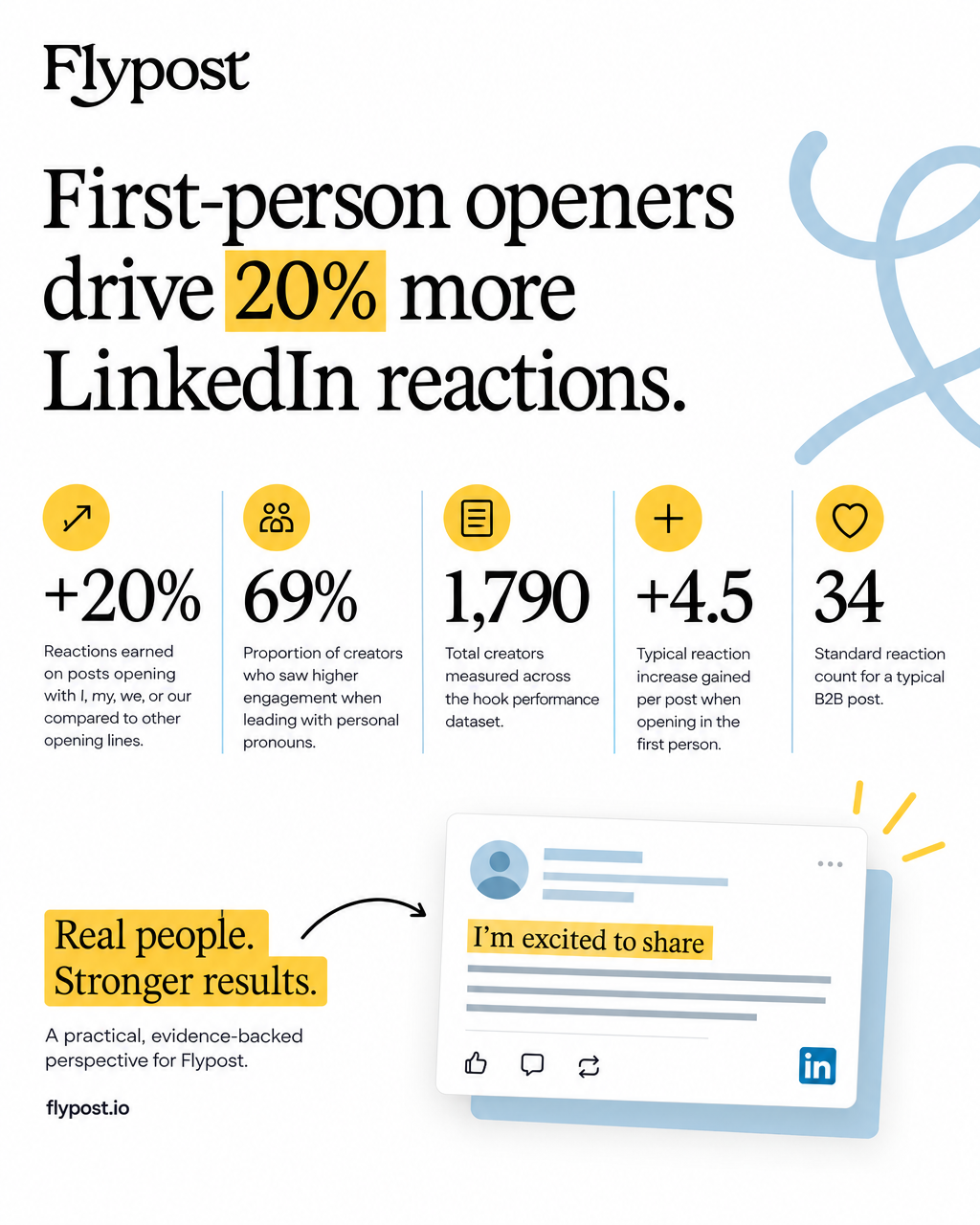
Posts whose first line opened with I, my, we or our earned about 20% more reactions than the same creator's other openers. That was measured across 1,790 creators, and 69% of them came out ahead. In absolute terms the typical post gained about 4.5 reactions, which on a typical B2B post of 34 reactions is a real move rather than a rounding error.
It is the second-strongest effect in our whole LinkedIn algorithm study, behind only attaching an image.
This one survived harder checking than anything else on the page, because our first assumption was that it must be something else in disguise.
- It is not a format effect. First-person posts carried an image 56.0% of the time against 56.1% for everything else. Identical.
- It is not a length effect. They ran to a median of 1,064 characters against 1,039. Also identical, and post length barely moves engagement anyway.
- It is not driven by one format. Split three ways it holds in each, with 63% to 70% of creators benefiting every time.
So what is left is the writing itself. LinkedIn readers reward a post that sounds like a person describing something that happened to them, and they can tell from the first line.
Instead of
Most founders get their first sales hire completely wrong.
Try
I hired the wrong head of sales twice before I understood what I was getting wrong.
Contrarian claim → something you did · Illustrative example, written by us. Not a real post from the study.
Instead of
Here are 5 lessons from 10 years in B2B marketing.
Try
We spent 10 years selling B2B the hard way. Five things I would tell myself at the start.
Listicle framing → first person · Illustrative example, written by us. Not a real post from the study.
Same subject, same information, same length. The second version of each simply reports something the writer did.
Do question hooks work on LinkedIn?
No. Opening with a question was the worst archetype we tested: about 15% fewer reactions than the same creator's other openers, across 446 creators, with only 32% benefiting.
This is the rare case where the evidence converges from three different directions. Our own algorithm study notes that AuthoredUp ranked question hooks last of the five styles it tested across 309,614 posts, and MagicPost measured a 34% penalty across 1.2 million. Three studies, three different methods, same answer.
It also corroborates from the other end of the post. Separately we found that ending with a question produced a typical gain of zero comments while costing about 10% of reactions, across 723 creators. Question-shaped writing underperforms at both ends of a post, which is a strange result for the single most repeated tip on LinkedIn.
Opening with a question cost 15% of reactions. Only 32% of the creators who tried it came out ahead.
The likely reason is not mysterious. A question in the first line asks the reader to do work before you have given them anything. First-person openers do the opposite: they hand over a fact and let the reader decide whether they want the rest.
Do "unpopular opinion" hooks work on LinkedIn?
They do exactly nothing.
Contrarian openers built on stop, never, nobody, wrong or unpopular came out at 1.00× across 365 creators, with 48% benefiting. That is a coin flip, measured on the people who actually use the technique.
The claims made for it are not small. Postiz says the "Unpopular opinion:" opener "can triple engagement". Across the creators in our sample who use it, it moved their median by nothing at all.
Should you start a LinkedIn post with a statistic?
Also exactly nothing: 1.00× across 170 creators, with 51% benefiting.
This is the one hook finding where a serious study disagrees with us, and it is worth flagging rather than burying. MagicPost's analysis of 1.2 million posts found first lines containing a number earned more likes, 35 median against 26.
The methods differ in a way that explains the gap. Theirs compares posts by different people, so it partly measures who writes stat-led hooks. Ours compares each creator against themselves, and within a creator the effect disappears. We think ours is the fairer test, but 170 creators is our smallest hook sample, so treat this one as a strong hint rather than a settled number.
Should you write "you" in a LinkedIn hook?
Openers built on you and your, the "You need to stop doing this" shape, cost about 9% across 1,303 creators. Only 38% benefited, which is the second-lowest hit rate on the page.
It is the mirror image of the first-person finding, and the two together are the clearest signal in this data: write about yourself, not at the reader. The same sentence can usually be turned around at no cost.
Instead of
You're probably measuring your LinkedIn engagement wrong.
Try
I was measuring my LinkedIn engagement wrong for about two years.
At the reader → about yourself · Illustrative example, written by us. Not a real post from the study.
How long should a LinkedIn hook be?
There is no length that wins. Against a 40 to 80 character baseline:
| First line length | vs baseline |
|---|---|
| Under 40 characters | 1.07× |
| 40 to 80 characters | baseline |
| 80 to 140 characters | 1.00× |
| 140 characters and over | 1.08× |
Short openers and long openers both come out marginally ahead of the middle, which is not a pattern, it is noise. "Keep your first line short" has no support in our data, and neither does its opposite.
This lines up with what we found on the body of the post, where chasing an ideal post length turned out to be measuring images and account size rather than length. Length is a symptom of having something to say, at the top of the post as much as anywhere else.
How do you write a better LinkedIn hook?
In order of how much the data supports it.
- Start with something you did. "I", "my", "we". It is the only archetype that beat a creator's own baseline, and it worked for roughly 7 in 10 of them.
- Delete the question mark. Not at the start, not at the end. Ask when you genuinely want an answer, not as an engagement tactic.
- Stop turning the opener around on the reader. "You need to" costs about 9%. The same point made in the first person does not.
- Drop the formula. Contrarian phrasing and stat-led openers both measured at zero. The time goes further on the thing you are actually reporting.
- Write the first line to the length the sentence needs. No band beat any other.
- Then attach an image. It is worth +33%, more than any hook, and the two effects are independent of each other. Details in the full algorithm study.
How we tested LinkedIn hooks
The same method as the rest of our research, and the same limits.
The sample. 2,500 English-speaking B2B creators between 1,000 and 500,000 followers, individuals only, spread across region and follower band. All posts collected in a single sweep in July 2026 covering the previous twelve months. Reshares excluded. Nothing counted until a post was at least 14 days old. Medians throughout, never means.
Defining the hook. First line means the text before the first line break. Posts with no line break at all were excluded, as were image-only posts with no text, so the hook analysis runs on a subset of the roughly 86,000 posts in the study rather than all of them. We sanity-checked the extraction before classifying anything: median hook 75 characters, interquartile range 49 to 129.
The test. Every number on this page is paired within creator: a creator needed at least four posts on each side of the comparison to count, and creators who tied exactly are excluded from the "who benefited" percentages rather than counted as losses. Sample sizes differ per archetype because not every creator writes every kind of hook, and they are stated with each finding.
What this page cannot tell you. Three things, honestly.
This page is one finding from our LinkedIn algorithm study of 130,000 posts, which tested eleven common rules the same way. See also how long a LinkedIn post should be and every LinkedIn character limit.
Spot a flaw? We would genuinely like to know. Tell us and we will correct it here.
Frequently asked questions
- What is a LinkedIn hook?
- The first line of your post, meaning everything before your first line break. It is the part that carries the post, because only about 210 characters on desktop and 140 on mobile show before the '…see more' fold. In our sample the typical first line ran to 75 characters.
- What makes a good LinkedIn hook?
- Writing in the first person. Posts whose first line opened with 'I', 'my', 'we' or 'our' earned about 20% more reactions than the same creator's other openers, across 1,790 creators, and 69% of those creators benefited. It held in text, image and video posts alike.
- Do question hooks work on LinkedIn?
- No. Opening with a question was the worst archetype we tested: about 15% fewer reactions than the same creator's other openers, across 446 creators, with only 32% benefiting. Ending with a question does not help either.
- Do 'unpopular opinion' hooks work on LinkedIn?
- They do nothing measurable. Contrarian openers built on 'stop', 'never', 'nobody', 'wrong' or 'unpopular' came out at exactly 1.00× against the same creator's other hooks, across 365 creators, with 48% benefiting. That is a coin flip.
- Should you start a LinkedIn post with a statistic?
- It made no difference in our data. Hooks containing a number came out at exactly 1.00× across 170 creators, with 51% benefiting. Note that MagicPost found the opposite comparing across different posters, so this is the one hook finding where a serious study disagrees with us.
- How long should a LinkedIn hook be?
- There is no length that wins. Against a 40 to 80 character baseline, first lines under 40 characters came out at 1.07×, 80 to 140 at 1.00× and 140+ at 1.08×. The 'keep your first line short' rule has no support in our data.
- Do LinkedIn hook formulas work?
- Four of the five archetypes we tested did nothing or actively cost reactions. The only one that worked was writing in the first person, which is a habit rather than a formula: it means the post is about something you actually did.
Written by
Sam Cassman
Founder, Flypost · Chiang Mai, Thailand
I'm Sam. I built Flypost after watching too many good businesses sit on years of material (blog posts, call transcripts, case studies, half-finished decks) and post almost none of it.
I write everything here myself. When I claim something works on LinkedIn, it's because I tested it first-hand or ran the numbers across our own data. Where I'm working from a small sample, I'll say so. I'd rather be useful than certain.